

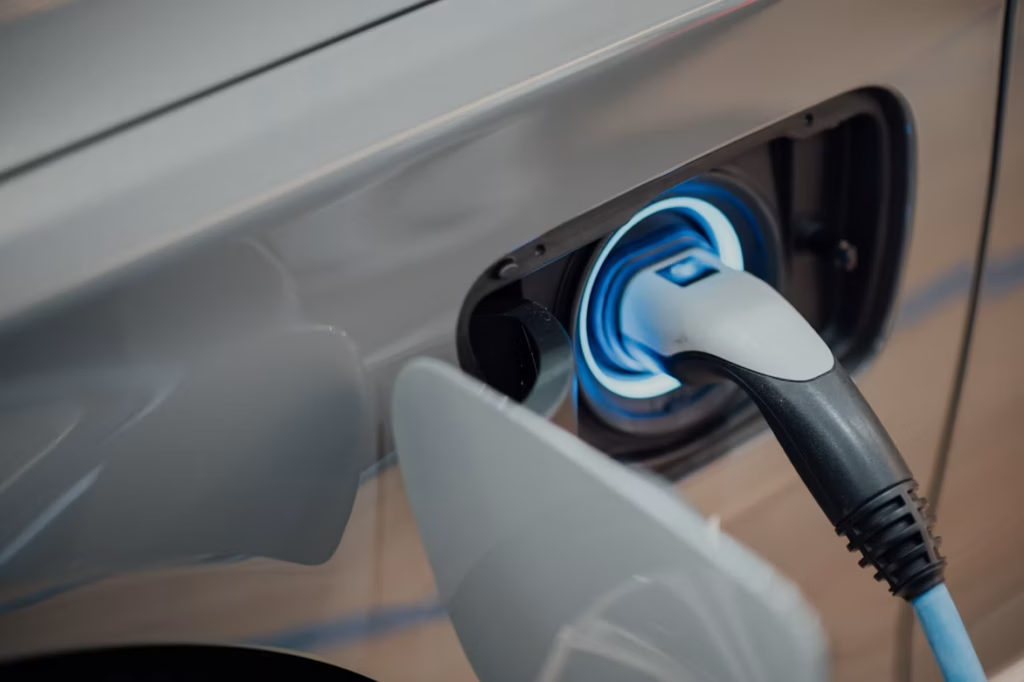
Electric vehicles, home batteries, induction cooking and electric heating are changing the way Victorian homes and businesses use electricity. These technologies can improve efficiency and reduce energy costs, but they can also place much greater demand on an electrical supply—particularly when several high-powered appliances operate at the same time.
In a recent technical email sent to electrical contractors, United Energy reported a 350% increase in blown service fuses over winter within its network. The distributor noted that increasing numbers of EV chargers, batteries and high-powered electric appliances are contributing to demand that some existing electrical installations were never designed to support.
The good news is that the risk can often be reduced through sensible energy management, correct equipment settings and, where necessary, an electrical or supply upgrade.
What is a service fuse?
A service fuse is an important safety device on the incoming electricity supply to your property. It is designed to disconnect the power if a fault occurs, unsafe conditions develop or the electrical load exceeds the capacity of the supply.
When a service fuse operates—often described as a “blown fuse”—the entire property may lose power. Unlike resetting a circuit breaker, restoring supply generally requires attendance by the electricity distributor to replace the fuse. This can cause considerable inconvenience and may also result in associated charges.
In Victoria, service fuses are commonly rated at 50 amps, although their size can vary depending on the property, its age and its location. A 50-amp service fuse can be placed under significant pressure when an EV, battery or several major appliances are drawing power together.
Why is this becoming more common?
Many older properties were designed when household electricity use was much lower. Today, a home may be charging an EV and a battery while also operating electric heating, an induction cooktop, an oven, a clothes dryer or air conditioning.
United Energy provides a useful example of the demand involved: a typical EV charger may draw around 32 amps, while a battery charging from the grid may draw around 40 amps. Even before other household appliances are considered, either load can use a large proportion of the capacity of a typical 50-amp service fuse.
The risk may be greater when customers concentrate their electricity use into a discounted or free-energy period. Charging an EV and battery while running heating, cooling or cooking appliances may save money under the tariff, but the property’s electrical system must still be capable of safely carrying the combined load.
United Energy also warned contractors about situations where a main circuit breaker has been increased to accommodate an EV charger or battery, but the service fuse and consumer mains have not been assessed or upgraded to match. An electrical installation is only as capable as its lowest-rated component.
How can you reduce the risk of a blown service fuse?
1. Spread high-powered electricity use across the day
Where practical, avoid operating multiple high-demand appliances at the same time. For example:
Schedule your EV to charge at a different time from your home battery.
Avoid charging an EV while using electric heating, air conditioning, an induction cooktop or an oven.
Stagger the use of appliances such as clothes dryers and dishwashers.
Take care when concentrating several major loads into a three-hour free-power period.
Spreading demand may be an effective solution for some properties, but it should not replace a professional assessment where the electrical supply is already operating close to its limit.
2. Review the EV charging rate
An EV charger does not always need to operate at its maximum possible rate. Reducing the charging current can lower the peak demand on the property while still allowing the vehicle to recharge overnight or during another convenient period.
Lux Electrical can assess the available supply capacity and help establish a practical EV charging rate. Where compatible equipment is installed, dynamic load management may also allow the charger to respond automatically to the electricity being used elsewhere in the property.
3. Set an appropriate battery import limit
Some battery systems can be configured to limit the amount of power they draw from the grid. The appropriate setting must account for the lowest-rated part of the installation, which may be the service fuse, consumer mains cable or main circuit breaker.
These settings generally need to be adjusted through the manufacturer’s installer access or with support from the manufacturer. They should be based on a proper assessment—not guesswork.
4. Have the property’s maximum demand assessed
Before installing an EV charger, battery, induction cooktop, large heating or cooling system, or other high-powered equipment, a registered electrical contractor should assess the property’s existing and likely future demand.
This assessment should consider:
the service fuse capacity;
the size and condition of the consumer mains cables;
the rating of the main circuit breaker;
existing major electrical loads;
which appliances are likely to operate at the same time; and
foreseeable future additions, including another EV or further electrification.
Customers should never attempt to access, remove or replace a service fuse themselves.
5. Upgrade the installation or incoming supply where required
If demand management alone is not a suitable long-term answer, the property may require one or more upgrades. These could include:
upgrading the consumer mains cables;
replacing or correctly rating the main circuit breaker;
applying for a larger service fuse; or
upgrading from single-phase to three-phase power, where available.
A supply upgrade requires assessment and approval by the relevant electricity distributor. It may involve work both within the property and on the electricity network.
How Lux Electrical can help
Lux Electrical Pty Ltd has the experience to assess both current and future electricity requirements for homes and businesses. We can assist with:
calculating maximum demand;
assessing the service fuse, consumer mains and main circuit breaker as a complete system;
reviewing and adjusting suitable EV charging rates;
coordinating battery import-limit requirements with the relevant installer or manufacturer;
upgrading consumer mains cables and main circuit breakers;
arranging applications for service-fuse or incoming-supply upgrades; and
assessing options for a three-phase supply where available.
The right solution is not necessarily the largest upgrade. In some cases, better load scheduling or a revised charging rate may be sufficient. In others, an upgrade may provide the safest and most practical capacity for the property’s future needs.
Concerned about your electrical capacity?
If you have installed—or are considering—an EV charger, home battery, induction cooktop, electric heating or other high-demand equipment, it is worth checking whether your existing electrical supply is suitable before an outage occurs.
Contact Lux Electrical Pty Ltd to arrange an assessment. We can inspect your installation, calculate the likely demand and explain the available options in clear, practical terms.
For further customer information, read United Energy’s excellent guide: Understanding your electricity needs.
Sources and further information
This article is based on information contained in United Energy’s recent technical email to electrical contractors, “How to help prevent blown service fuses,” together with the following resources supplied in that communication:
The information in this article is general in nature. Every property and electrical installation is different and should be assessed by a suitably licensed electrical professional.